East Norwalk Residents Take Part In TOD Visioning Workshop
The East Norwalk Transit Oriented Development Plan effort took a big step forward in March as area residents met with planners for the first visioning workshop with the public. About 80 people attended to learn about the planning process, goals of the plan and to give their input and share ideas on how they envision the future of the area.
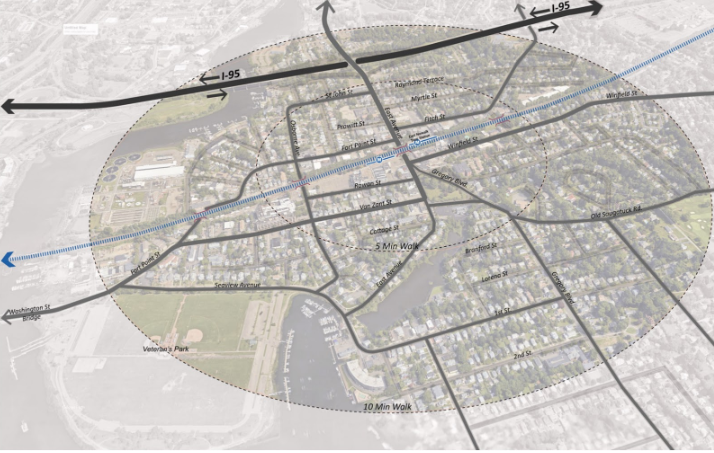
East Norwalk Transit Oriented Development Area
Following a short
presentation from the consultant team, Harriman, attendees were led through a series of group exercises. These exercises were meant to engage the community in how they use this area on a day-to-day basis. This information, coupled with interviews with key community stakeholders such as business and property owners, neighborhood associations and advocacy groups, will help the consultant team and the City develop questions and areas to focus on during the planning process.
The first exercise allowed participants to think about their daily patterns and the most frequent routes they take within the East Norwalk neighborhood. The second exercise was a more formal discussion of how the community uses the area, including challenges and opportunities faced by the public. The third exercise captured the community’s aspirations for the area and the kind of amenities they would like to see within a 5-minute and 10-minute walking distance of the train station.
Overall, the group said they liked the small community, village feel of the East Norwalk neighborhood. They also liked the access to open spaces such as Taylor Farm, Veteran’s Park and the beach. Factors they would like to see addressed in the area included broken infrastructure, uneven sidewalks and lack of crosswalks, traffic control, especially the number of trucks, and what was seen as too many gas stations.
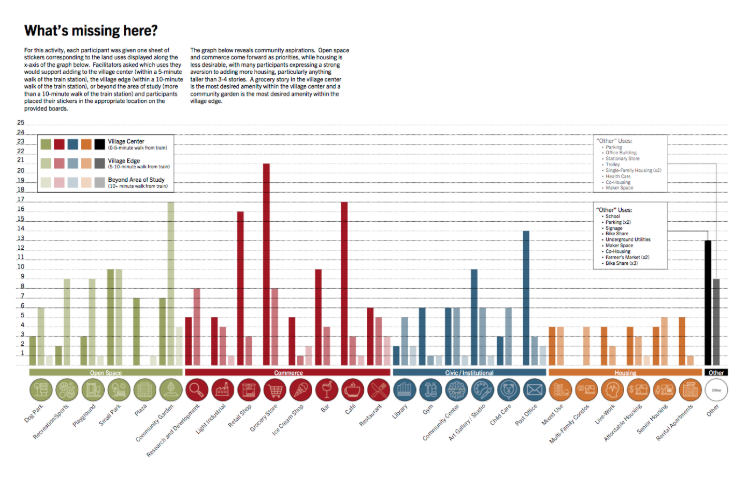
There were several aspirations for the East Norwalk TOD area that came forward as priorities during the exercises, including open spaces such as a small parks and playgrounds, and more commerce such as retail shops and restaurants. Within the village center, a grocery story was the most desired amenity. A large number of participants also expressed the desire to have a post office within the village center. A community garden was the most desired amenity at the village edge - within a 10-minute walking distance from the train. Less desirable to include in the future was additional housing, with many participants expressing a strong aversion to adding more housing, particularly anything taller than 3-4 stories.
Participants were also asked to complete comment cards to gain further feedback. Some of the comments are below:
We need smart development at the train station that improves walkability and encourages small businesses (café at train, small market). We need a small park in the center of East Norwalk you shouldn’t have to go to the beach or the Green to enjoy public space.
The repair of existing infrastructure is the place we should start. Cleaning up areas and adding clean affordable landscaping in spots that can use it.
East Norwalk occupies some 1/3 of Norwalk’s coastline, a significant geographic reality conclusive of the maritime tradition of East Norwalk; an aspect which must be championed in the effort to preserve the uniqueness of East Norwalk as a small community.
Keep the area a beach/maritime community. Add more walkable retail/ restaurants/small office space. Zoning changes to fit vision.
The full results from the visioning workshop and other evaluations have been synthesized by the consultant team, who have prepared a full summary of the insights gained and major takeaways. Draft vision principles are being prepared that will guide and shape the future direction for the area.
See Full Workshop Results, Market Analysis and Other Evaluations Here.East Norwalk Transit-Oriented Development Plan Update
Other Planning Efforts
Along with and helping to shape the East Avenue Transit Oriented Development Plan, the city is also conducting a Citywide Plan/POCD, a Wall Street/West Avenue and Washington Street/South Main neighborhoods Plan as well as a citywide Parking study. Timeline: TOD
Have A Say In Your Norwalk, Your Future
The City has partnering with the Third Taxing District, the East Norwalk Neighborhood Association and the East Norwalk Business Association on the East Norwalk Transit Oriented Development study. Planning has also included conversations with real estate and economic development professionals, as well as input from businesses and City representatives - and area residents like you!
If you have any questions about the planning efforts, contact Steve Kleppin, Director, Norwalk Planning and Zoning, at
skleppin@norwalkct.org or (203) 854-7780
Transit Oriented Development and What It Means For Norwalk

Transit oriented development (TOD) is development that looks to create compact, pedestrian-oriented, mixed-use communities centered around high quality public transit systems. This type of development is designed to revitalize cities and their neighborhoods, and provides a number of benefits. Below are some key characteristics of TOD, its benefits and how it is being implemented right here in Norwalk, CT.
The last century saw the growth of the suburbs, with greater and greater sprawl outside of cities, and transportation emphasizing cars and highways. The trend this century is moving toward existing cities. Millennials, soon to be the largest generation - surpassing baby boomers - tend to stay or move into more dense, urban, mixed-use neighborhoods.
Read more about that here. Close proximity to shopping, theater, restaurants and transit is important to them. In addition, transportation is focusing on more sustainable models of public transportation.
Characteristics of Transit Oriented Development
Transit oriented development is the perfect solution for these trends. So what exactly does TOD look like? Here are five key characteristics:
Accessible Public Transportation
The term transit-oriented, explains it all. The neighborhood has quality public transit facilities -trains, buses, light rail -as a prominent feature or center of the community. Most of the housing is close to the transit center (ideally within a 10-minute walking distance), decreasing sprawl and promoting compactness.
Compactness/High Density
The TOD area has a mixture of uses in close proximity including residences, offices, retail and civic facilities. There are even certain retail outlets conveniently located at the transit stations serving commuters such as, cafes, grocery and dry cleaners.
Walkability
With compactness comes easy walking distance to most amenities. This makes a priority of having a neighborhood with a walkable design for pedestrians. Streetscapes, including wide sidewalks, crosswalks and lighting, are built with the pedestrian in mind. Shying away from the traditional car-centric neighborhood.
Bikeability
TOD design also includes making it easy to use bicycles and scooters by having bike lanes and ride-in bicycle parking areas within the transit stations. A plus would be a bikeshare rental system and network integrated in conjunction with public transit facilities.
Easy Parking
Parking is carefully located and managed within the neighborhood, not to encourage cars in place of public transport, but to encourage visitors from outside the neighborhood and economic development. Not yards of parking lots in the center, but shared parking structures on the outskirts of the TOD area. This encourages use of other transit options including bikes, light rail, and walking.
Benefits Of Transit Oriented Development
Creating new TOD communities and promoting existing dense, walkable neighborhoods bring about a number of benefits for cities, people, and the environment. Here are just a few things TOD is good for:
- Environment - Reduces the need for driving, increases transit ridership and lowers energy consumption, pollution and environmental damage.
- Health - more walking, and less stress makes for healthier people
- Safety - Reduced traffic congestion, car accidents and injuries
- Economy –with people living and working in the neighborhood, it increases foot traffic and customers for area businesses
- Municipalities - Less expensive than building roads and sprawl, more taxable income from the increase in residences and businesses.
- Quality of life – a dense, compact neighborhood brings places to live, work, and play – all within easy reach
TOD in Norwalk
As part of Norwalk’s efforts to revitalize urban neighborhoods, it has designated a TOD area in South Norwalk, centered on the South Norwalk Railroad Station. A transit-oriented development plan is in place, encouraging a mixed-use, mixed-income district with adequate amenities, ease of getting around, public safety requirements, and open space.
Part of this plan allows a higher residential density closer to the South Norwalk Rail Station. Norwalk’s guidelines for both private development and public infrastructure ensure new development is consistent with the goals for a walkable, mixed-use district that is connected to the rail station, the waterfront, and the surrounding residential neighborhoods. To maintain a diverse neighborhood, a mixture of housing is encouraged, including low to moderate-income housing. In addition, zoning helps to preserve and protect the historic character of the neighborhood. Infrastructure improvements are also planned including roadway, parking, and sidewalk enhancements.
Recent initiatives toward the TOD goal include, a privately built 66-unit apartment building, the SoNo Pearl and a hotel, the SoNo Residence Inn both located within walking distance on the South Norwalk Train Station. Work has begun on the Washington Village Transformation Plan, part of the federally funded Choice Neighborhoods Grant, centered on mixed income housing near Day Street and Water Street.
Transit oriented development capitalizes on the increasingly popular trend toward living in cities by creating cohesive and attractive environments in which to live, work, shop, visit, and enjoy in neighborhoods around major public transit hubs. The emphasis on renewing these areas will encourage sound growth and development of the community – a win-win for municipalities, businesses and people.
Norwalk Receives State Grant to Plan Transit-Oriented Development Near East Avenue Train Station
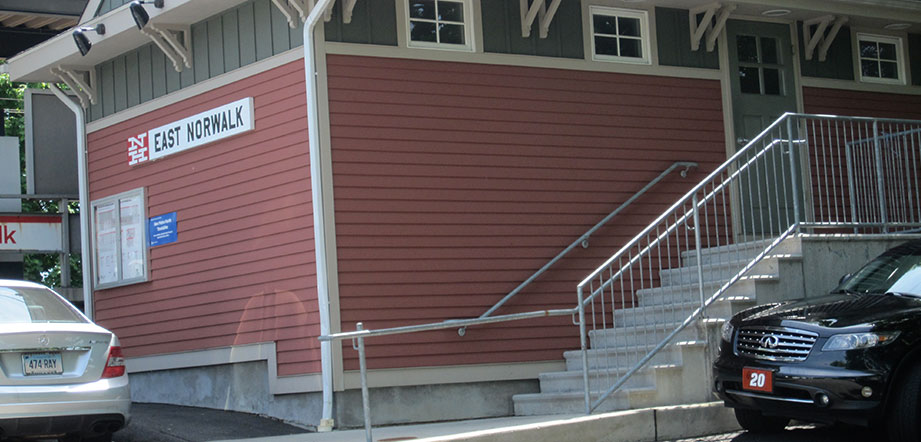
Norwalk is among the recipients of funding that will help the city to develop in ways that will encourage the use of public transportation and discourage vehicle dependence and congestion. The $125,000 grant, from the 2017 Responsible Growth and Transit-Oriented Development Grant Program administered by the Office of Policy and Management, will go toward analysis and creation of a transit-oriented development plan for the area surrounding the East Avenue railroad station in East Norwalk. The grant was announced by Governor Dannel Malloy’s office late last month.
Transit-oriented development integrates housing, office, retail and/or other amenities into a walkable neighborhood, within walking distance (generally a half-mile) of public transportation. Currently, the area around the East Norwalk train station is conducive to such development based on existing land uses and the lack of a cohesive vision for the area. The East Avenue planning study will analyze existing conditions, opportunities and constraints to transit-oriented development around the train station in order to develop a clear framework and vision for the future of the area. In addition, the study will establish guidelines for design and development. In these efforts, the city will partner with the Third Taxing District, the East Norwalk Neighborhood Association and the East Norwalk Business Association, as well as include the input of property owners, residents and businesses around the station to understand what their vision for the area may be.
In making the grant announcement, Governor Malloy stated, “Transportation isn’t just about cars, trains and buses – it’s about building vibrant communities and continuing to make Connecticut a more attractive place to live, visit, and do business.”
In total, eleven projects in towns and cities across Connecticut will receive $15 million in funding from the 2017 Responsible Growth and Transit-Oriented Development Grant Program. Other cities receiving grants include New Britain, Stratford and Wallingford.
For the full Governor’s announcement
CLICK HERE